While evaluating Injection Molds Service in Houston, it is important to work with partners who consistently provide precision, swift turnaround, and consistent production. Houston-area molding specialists frequently provide in-house mold design and tooling. These capabilities enable close coordination with engineering teams, allowing quick modifications within nearby facilities.
Prioritize providers that bring together tool design, prototype production, and assembly into a unified production system. Many regional businesses provide full-service manufacturing support for industrial injection molds, serving multiple industries, including consumer products, automotive, healthcare, and OEM.
Selecting a local injection mold service ensures closer supervision, clearer communication, and faster market access. For a direct contact in the area, consider www.lowrancemachine.com. Its capabilities include mold design, tooling, and plastic injection molding for Houston clients.
Why Houston Excels In Mold Design And Industrial Tooling
Engaging Houston-based mold-design professionals can significantly benefit your project. The city’s strong engineering base ensures teams are equipped with the latest two-dimensional and three-dimensional CAD platforms. They conduct hands-on reviews and hold on-site meetings to promptly correct any issues. This proximity minimizes communication delays, encouraging greater client involvement in design reviews and tooling inspections.
Local manufacturing plants make it easier to arrange in-person trials and approval sessions. This proximity reduces the cost of engineering changes and compresses the feedback loop for revisions. Hands-on local coordination supports shorter development schedules and fewer unforeseen complications during the ramp-up phase.
Several key sectors drive consistent demand for industrial injection molds throughout Houston. Automotive suppliers require components for both interior and under-the-hood applications. Heavy-industry producers need durable mechanical parts, while electronics manufacturers demand precision tooling for compact components. Healthcare-product companies create non-critical parts, and specialized original-equipment manufacturers move early designs into full production.
Such industries benefit from Houston because of its well-developed supplier network, which enables efficient prototype-to-production progression. Moving from a small test run to full tooling is seamless, reducing the extended interruptions associated with distant vendors. Local mold design Houston resources adapt designs for reliable production across these markets.
Using injection molders based in the United States provides distinct logistical and manufacturing advantages. This approach removes the need for extended overseas shipping, customs, and long lead times. Locally produced molds supports more direct oversight, limiting corrective work and speeding up design changes when quick changes are necessary.
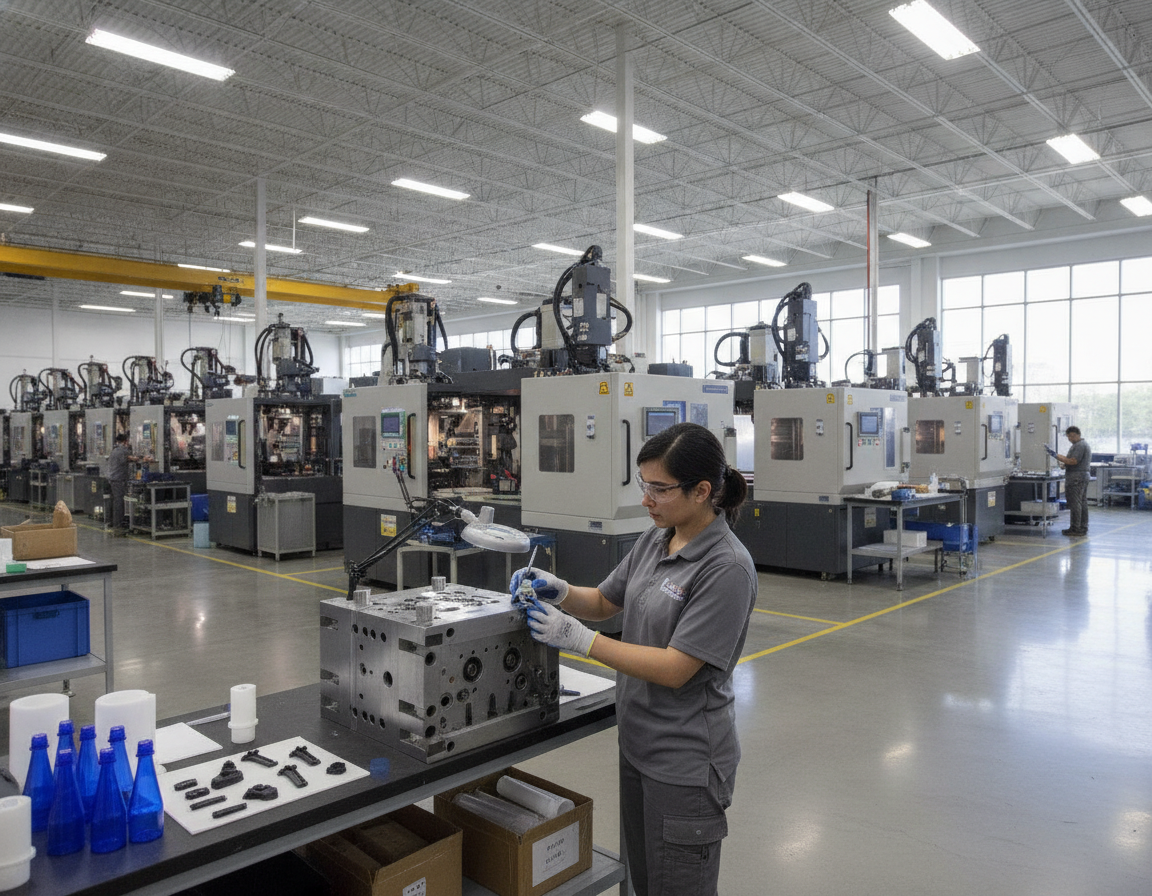 Mold Design Houston
Even though American-based mold production may carry higher initial tooling costs, it often enhances time-to-market and total cost of ownership. Faster iterations and lower transportation and customs risks help reduce long-term expenditure and accelerate commercial availability.
| Key Strength | What You Gain | How Houston Delivers |
|---|---|---|
| Access to technical specialists | Faster design validation and fewer errors | Houston engineering expertise with on-site consultations and CAD support |
| Broad market capability | Flexible tooling across numerous industries | Houston industrial-mold capabilities for automotive, healthcare, electronics, and OEM projects |
| Project turnaround | Reduced product-development timelines | Nearby engineering and manufacturing facilities accelerate shipping, trials, and updates |
| Process quality | Lower rework and predictable output | American manufacturing requirements and hands-on process monitoring |
| Total cost | Better lifecycle value | Faster iterations and reduced logistics offset higher tooling investment |
Injection Molding And Tooling Services In Houston
Throughout Houston, a wide array of services caters to the full injection-molding lifecycle. Available capabilities include mold design, tooling fabrication, and prototyping. They also offer injection molding, assembly, finishing, and contract manufacturing. Providers offer various mold types, such as two-plate, three-plate, insulated, and cold-runner tooling, along with low-cavity and high-cavitation mold systems.
Scope Of Services You Can Find
Emerging companies and established OEMs turn to Houston’s injection molding services for quick concept parts and pre-production batches. They provide full production manufacturing, including high-output tooling with automated component movement. Their services can extend to integrated assembly and post-molding work such as sonic welding, printing, and marking. For projects requiring tighter control, material analysis, shade matching, and production-batch traceability are available.
Houston-Area Manufacturers And Their Strengths
Local manufacturing businesses showcase different areas of expertise. Geospace Technologies boasts internal toolmaking, automated systems, and molding capacity reaching 90 ounces. The company’s molding machines include Cincinnati, Arburg, Wabash, AutoJector, MiniJector, and Van Dorn equipment. Haumann Technology specializes in OEM programs and contract-manufacturing projects, with an emphasis on expandable high-volume manufacturing and experience in multiple industries. RMC’s Houston plant is known for quick turnarounds and decades of experience, uniting engineering depth with shop-floor capacity.
How To Evaluate Houston Mold Manufacturers
While comparing providers, review their engineering knowledge, staffing, and tooling-design abilities. Determine their tooling and sample throughput to match your required delivery window. Evaluate their available molding presses and injection capacity to verify their machinery suits your product requirements.
Investigate their robotic capabilities, extended-shift capacity, and quality-management procedures, such as recognized ISO credentials. Obtain project references within your market and evaluate their communication protocols for design feedback, modifications, and formal change control. Verify they allow your input during mold development and manufacturing and document how they manage lead times and revisions.
| Evaluation Category | Questions To Raise | Why This Is Important |
|---|---|---|
| Mold-design expertise | Do you perform mold design Houston work in-house? What CAD/CAM tools do you use? | Internal engineering accelerates revisions and limits mistakes when designs move into toolmaking |
| Tooling and mold types | Can you build cold-runner, two-plate, three-plate, and multi-cavity molds? | Selecting the proper mold configuration improves resin efficiency and cycle speed |
| Press availability and injection capacity | Which press brands and shot capacities do you operate, including units above 60 to 80 ounces? | Correct shot capacity ensures part quality and avoids multiple changeovers |
| Robotics and production capacity | Are automated handling, line-side assembly, and round-the-clock production options available? | Automation raises consistency and reduces per-part labor costs |
| Inspection standards and certifications | What quality certifications, testing systems, and inspection procedures are in place? | Formal credentials and traceable inspections reduce compliance risk |
| Project coordination and revision management | How are revisions approved, documented, and incorporated when a schedule must be accelerated? | Clear processes prevent delays and scope creep during mold build |
| Industry fit | Have you completed comparable projects for automotive, medical-device, or electronic-product clients? | Prior experience shortens learning curves and improves first-run yields |
Houston Precision Mold Design: Moving From Idea To Manufacturing
Converting an idea into repeatable molded components requires an organized development process. Within Houston-area facilities, local teams leverage advanced computer-aided design and manufacturing systems in conjunction with direct feedback from machinists and molding technicians. That process helps ensure moldability, accuracy, and cosmetic specifications are carefully reviewed before any steel is cut. Accurate upfront engineering reduces the need for major corrective modifications, ultimately reducing downtime when creating injection molds for Houston clients.
Digital Design Systems And Engineering Processes
Technical teams apply 2D and 3D modeling to meticulously plan cavities, cooling, and ejection systems. Simulation tools highlight filling problems, distortion, and sink marks, making possible geometry and gating adjustments before tool construction starts. This collaborative process with in-house engineers strengthens the reliability of mold-design projects, so that both mechanical and visual specifications are properly addressed.
Prototype Molds For Testing And Limited Production
Local tooling specialists produce prototype molds, including single-impression and small multi-cavity tools, to confirm designs before authorizing high-volume tooling. Such tooling choices, which include cold-runner and insulated molds, reduce initial costs while making room for material validation and process-timing tests. Such low-volume runs substantially lower project exposure and speed up engineering feedback.
Mold-Design Strategies That Improve Long-Term Value
Mold designers may propose multiple-cavity configurations when large annual output is expected, considering the upfront tooling expense. Well-designed material-delivery systems are also selected to shorten molding cycles and reduce waste. Selecting appropriate materials and finishes extends tool life, controlling the cost of each molded part. Thermally controlled tooling and optimized runner systems support rapid changes between materials or colours, increasing lifecycle value throughout the tool’s lifecycle.
| Phase | Common Engineering Resources | Customer Advantage |
|---|---|---|
| Initial concept | Two-dimensional drawings and specification documents | Rapid review of practicality and major cost factors |
| Design | 3D CAD and mold-flow analysis | Lower defect risk and more precise dimensional requirements |
| Prototype | Limited-cavity tools with economical runner systems | Design confirmation without full production-tooling costs |
| High-volume manufacturing | Hardened production molds with multiple cavities | Efficient production costs and consistent performance over extended runs |
| Ongoing operation | Maintenance plans and rework strategies | Extended tool life and predictable uptime |
Industrial Molds In Houston: Resins, Machines, And Production Capacity
Selecting the correct polymer is a key project decision, and Houston molders are well equipped to provide guidance. Widely used plastic resins such as polyethylene, polypropylene, and nylon fulfil a variety of mechanical and commercial applications. For parts demanding greater strength, heat tolerance, or specialised surface performance, modified polymers with glass fibre, mineral reinforcement, or metallic additives are often considered. Suppliers often consult databases such as MatWeb to advise on the most suitable materials for specific applications in Houston.
The specified molding material directly affects production speed, tooling abrasion, and secondary operations. For parts requiring flame resistance, chemical stability, or precise dimensions, engineered resin formulations or modifiers are suggested. Selecting the correct compound not only changes tooling requirements but also can lead to cost savings over the life of the manufacturing program.
The supplier’s molding-equipment range sets the facility’s practical production limits. A diverse machine fleet in Houston, featuring presses from Cincinnati, Arburg, and Van Dorn, creates flexibility in handling various shot weights and clamp forces. Such equipment variety allows for the manufacture of substantial components without dividing them, eliminating the need for additional joining operations.
While assessing a molding provider, consider the available molding machines, auxiliary systems, and supporting tools. Access to smaller toggle presses alongside high-tonnage units enables rapid mold trials and efficient production without the need for plant changes.
Robotic automation performs a major function in ensuring consistent quality and reducing labor variability. Robots can perform tasks such as part transfer, visual quality checks, and integrated testing, maintaining cycle consistency across shifts. This setup enables extended-shift manufacturing, maintaining standards and minimizing lead-time risks in high-volume production.
During production planning, determine whether the molder offers component traceability, SPC monitoring, and integrated inspection with robotic integration. These systems are valuable for preserving repeatable results during long production runs and meeting tight deadlines.
| Capability | Typical Benefit | Questions To Ask |
|---|---|---|
| Resin specification assistance | A resin matched to mechanical, thermal, and cosmetic requirements | Standard grades, custom compounds, additives, and documented material-property references |
| Available injection presses | Adaptability across component dimensions and output volumes | Press models, operating tonnage, injection capacity, dryers, robots, and temperature controls |
| Shot Size 90 Oz Houston | Ability to mold larger parts in a single shot | Confirmed press models and demonstrated runs at 90 oz |
| Automation | More consistent output with reduced material waste | Robots, vision systems, and in-line inspection capability |
| Multi-Shift Production | Improved capacity and reduced risk of missed schedules | Shift availability, backup personnel, maintenance planning, and process-performance records |
Quality Management, Certifications, And Industrial Standards
To achieve repeatable components from Houston injection molds, it is imperative to scrutinize a supplier’s quality management system. Leading manufacturers combine rigorous process control with repeatable inspection procedures. These controls safeguard the required shape, tolerances, and material characteristics. The manufacturing contract should outline the vendor’s approach to first-article inspection, in-process verification, and final acceptance standards.
Recognized quality certifications signify a vendor’s adherence to industry standards. Seek ISO certifications Houston, such as ISO 9001:2015 for quality management and ISO 13485:2016 for medical manufacturing controls. Aerospace suppliers typically hold AS9100D and ITAR registration. Environmental-management and workplace-safety standards such as ISO 14001:2015 and ATEX are also critical for certain applications.
Production Control and measurement procedures are important in ensuring parts match approved drawings and operate as expected. Expect the use of coordinate measurement, vision-based inspection, and documented statistical-process monitoring. First-article reports should include traceable measurements. Production-line checks and locked process windows help preserve repeatability over extended production periods.
For medical injection molding Houston, demand full resin traceability and applicable biocompatibility records. Manufacturers should preserve batch-specific certificates and formal modification records. Within flight-related programs, confirm performance certifications and strict change-control practices to support safe operation and regulatory conformity.
Houston quality management transcends mere documentation. It depends on trained personnel, calibrated test equipment, and documented corrective actions. Request information concerning a vendor’s audit history, supplier control, and record retention to support long-term project stability.
Tooling Costs, Delivery Schedules, And Prototype Versus Production Molds
As you plan a molding project, the upfront mold cost must be compared to the lifetime unit cost. Houston injection-mold pricing is determined by several factors. Pricing considerations cover the cavity count, mold material, cooling design, dimensional accuracy, and finish requirements. Multi-cavity configurations may increase the initial cost but decrease the cost per part as volume increases.
Selecting the best tooling approach depends on the planned service life of the tool and the target cost per part. That tooling choice is critical for controlling early investment while improving long-term economics.
What Affects Mold Pricing And Long-Term Value
A number of design choices can increase the cost of tooling. Examples include complicated shapes, demanding tolerances, and specialised metals. The choice of mold base, such as those from DME or Hasco, and the selected tool steel, such as P20, S136, or another hardened grade, also impacts the budget. Project planning should to consider future repairs, spare inserts, and the projected number of molding cycles when assessing long-term value.
A greater upfront tooling expense is justified when annual volumes exceed the break-even point for lower unit pricing. This approach improves sustainable lifecycle economics.
Typical Lead Times And How To Shorten Them
Lead times for injection molds in Houston are influenced by design difficulty. Simple tools with a single cavity can be produced on comparatively short schedules, whereas complicated high-cavitation or heated-runner projects may take a significantly longer period. Opting for a local Houston provider can compress the project schedule compared with international suppliers.
Accelerating mold completion is possible by delivering accurate CAD files, tolerances, and material data before engineering starts. Using standard mold components and approving prototype tools before full production construction can also reduce development delays.
Selecting The Appropriate Mold Configuration
Understanding the differences between prototype and production molds in Houston is important. Development tools are ideal for testing component shape, assembly fit, and practical performance at a lower cost and with faster turnaround. In contrast, high-volume tools are designed for high-volume runs and demanding cycle requirements.
Houston cold-runner tooling provide a cost-effective solution for a wide selection of plastic resins. These molds can control waste and make servicing easier, making them suitable for widely used thermoplastics. Houston insulated tooling allow rapid resin or colour transitions and support controlled thermal conditions for particular production requirements.
Standard two-plate tools are commonly selected for straightforward gate layouts and part removal, while three-plate tooling offer more flexibility in gate placement and parting-line options for components with demanding visual requirements at a greater investment. Choosing the most suitable mold design is essential for maintaining efficiency in your molding program.
| Tooling Decision | Prototype Approach | Full-Production Choice |
|---|---|---|
| Common completion period | 2–8 weeks for simple prototype tools | 8–20+ weeks for full production molds |
| Starting tooling expense | More economical construction using low-cavity layouts and development-grade metals | Premium tooling built for durability, output, and production-runner integration |
| Best use | Form-and-fit testing, market samples, and short manufacturing batches | High-volume production and long-lifecycle parts |
| Service requirements | Simpler servicing with faster corrective work | More extensive spare-part, preventive-maintenance, and refurbishment requirements |
| Material flexibility | Well suited to testing multiple polymers and additives | Engineered around the selected production polymer and operating window |
| Available gating and part-removal designs | Straightforward two-plate runner and gate layouts | Advanced two-plate or three-plate tooling with cold-runner, insulated, or specialised runner configurations |
Strategic planning to your molding plan is critical, considering volume forecasts and product priorities. By comparing the price of Houston injection tooling with tooling completion periods and the trade-offs between prototype and production molds, you can reduce project uncertainty and speed up commercial launch.
Contacting And Managing Your Houston Molding Partner
Initiate by compiling complete product information before engaging in a Houston mold consultation. Prepare 2D and 3D CAD files, the desired material, anticipated production quantity, and clear performance specifications. Additionally document the surface finish, colour, assembly needs, and regulatory constraints. Such thorough preparation enables engineers to suggest the best combination of tooling, materials, and production strategy with minimal adjustments.
Preparing Your Project For A Mold Design Consultation
- Offer CAD files in native or neutral formats along with a documented project brief detailing dimensional limits and measurement requirements.
- Specify the target cycle time and annual production volume to help define the correct cavity count and tool dimensions.
- Outline the required surface finish, colour accuracy, and post-mold operations such as sonic welding or assembly.
- Identify any compliance obligations for healthcare or aviation parts to prevent regulatory concerns from being missed during tool development.
Important Questions For Potential Molding Suppliers
- Ask about internal toolmaking resources and the Houston mold-design workflow from digital manufacturing through testing.
- Ask about the equipment lineup, clamp tonnage, and injection volume for local mold-production work.
- Determine the possibility of automation and multi-shift production for improved manufacturing capacity.
- Verify quality credentials such as ISO, AS9100, and ISO 13485 and the measurement procedures used.
- Ask for examples of related tooling work completed for similar industries and prototype-to-production timelines.
- Document the approach to managing design changes and sample capacity during the transition into regular manufacturing.
A Houston Manufacturing Resource To Evaluate
Consider evaluating local partners such as Lowrance Machine for mold design and injection molding in Houston. Compare their capabilities at Lowrance Machine’s Houston-area facility against those of regional competitors such as Geospace Technologies and Haumann Technology. Compare shot size, tooling scope, and assembly services to align with your project needs. Verified manufacturing resources and delivery estimates are important for selecting a supplier and coordinating the project timeline.
Conclusion
Injection molding support in Houston is your go-to for accelerating product development. Houston manufacturers serve a broad mix of markets such as automotive, commercial, medical-product, and consumer-technology sectors. With local mold-design teams, you enjoy direct cooperation, fast revisions, and immediate access to internal toolmaking. These advantages enable a faster move from early samples into manufacturing.
Using Houston industrial tooling brings numerous benefits. You gain access to a wide range of machine fleets, including large-shot machines and robotic production cells for consistent output. Houston’s injection molding partners also offer high-throughput shift coverage. They operate disciplined quality-management programs and hold certifications that meet the highest industry standards.
For a smooth tooling and production launch, it is essential to provide complete manufacturing requirements. Compare providers based on their technical depth, mold-building experience, quality credentials, and communication. To begin a local discussion, visit the manufacturer’s website. There, you can learn more about local injection molding and tooling capabilities and initiate a project discussion based on your requirements.
Related: The Ejection Mechanisms in Injection Molds in Houston